Creating Music That’s Loud, Aggressive and Straight to the Point
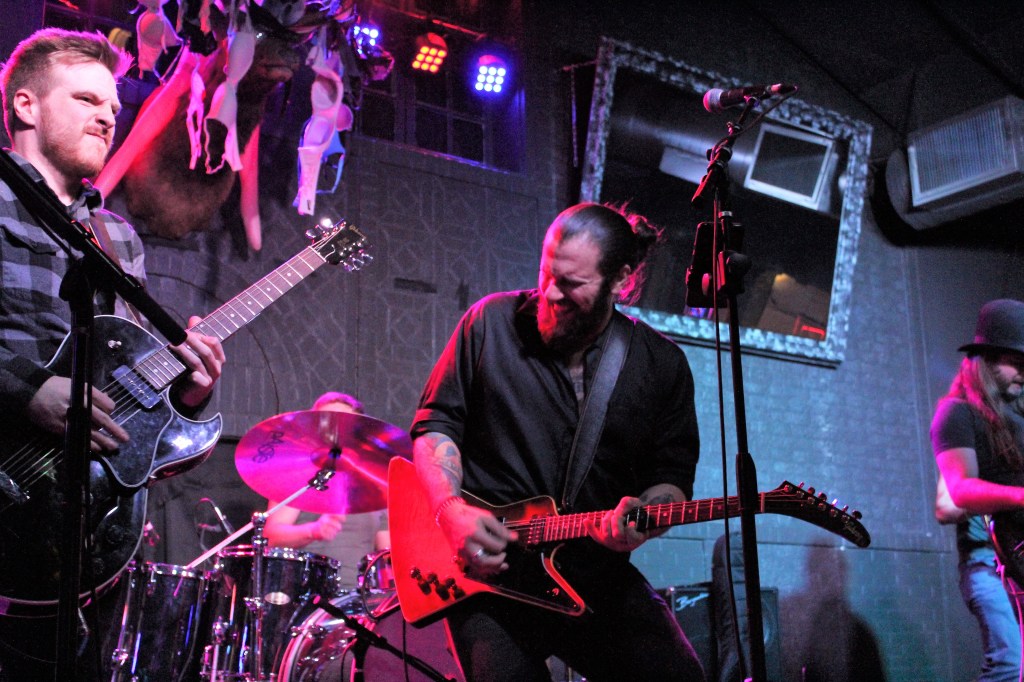
‘Three parts Detroit Muscle and one part New York Soul’ are just some of the ingredients of Nashville’s new rock band, King Locomotive. Since forming in August of 2020, the band has been writing original rock music laying down tracks and releasing songs towards the goal of completing what will ultimately become their first album.
Front man Brian Ripps (Lead Singer/Guitar) and Jacob Bishop (Lead Guitarist) joined me earlier this year to talk about the band, their backgrounds, musical influences, and vision for the music they want to create as ‘King Locomotive.’
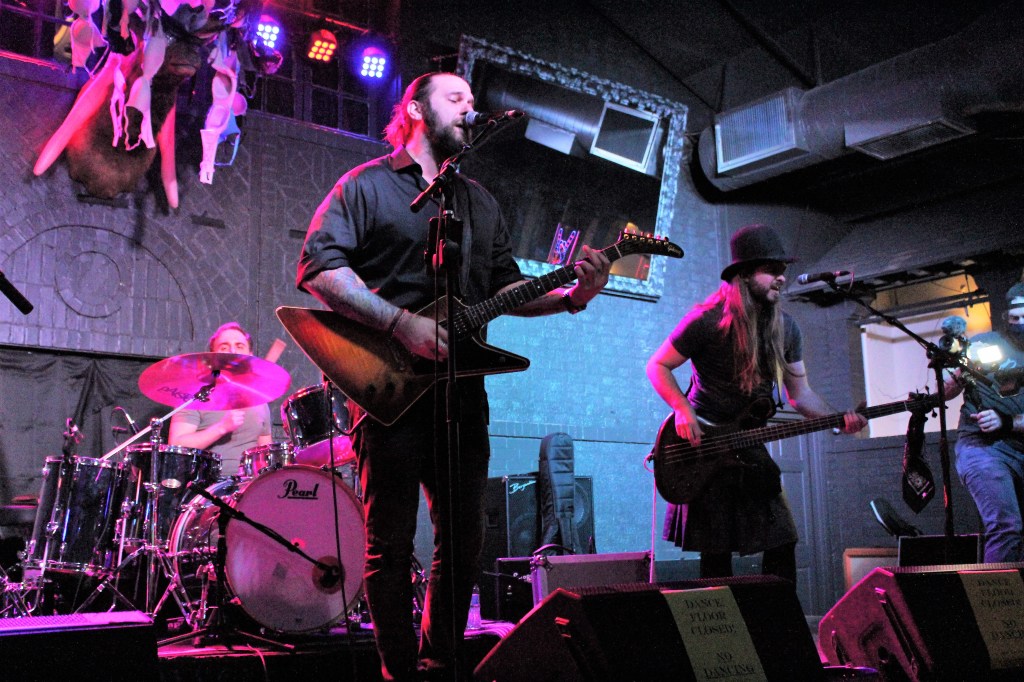
While the band is relatively new, Jacob Bishop (Lead Guitarist), Brandon Roberts (Bass), and Jon Amoe (Drummer) have a long history and brotherhood together, having played in bands with one another for many years while growing up in Detroit, Michigan.
BISHOP: I went all through Junior High School and High School with Brandon. Brandon grew up in metro Detroit, and he started playing in bands in high school and middle school. He ended up joining my band in high school called the Jake Bishop Band at the time. We played all throughout the Detroit area, and we did dates in Canada and Memphis for the big blues challenges and played a bunch. I got an offer to move here, so I did, and then Brandon came a few months later. I came to Nashville in September of 2010, and he came in January of 2011. Brandon and I both are 28.
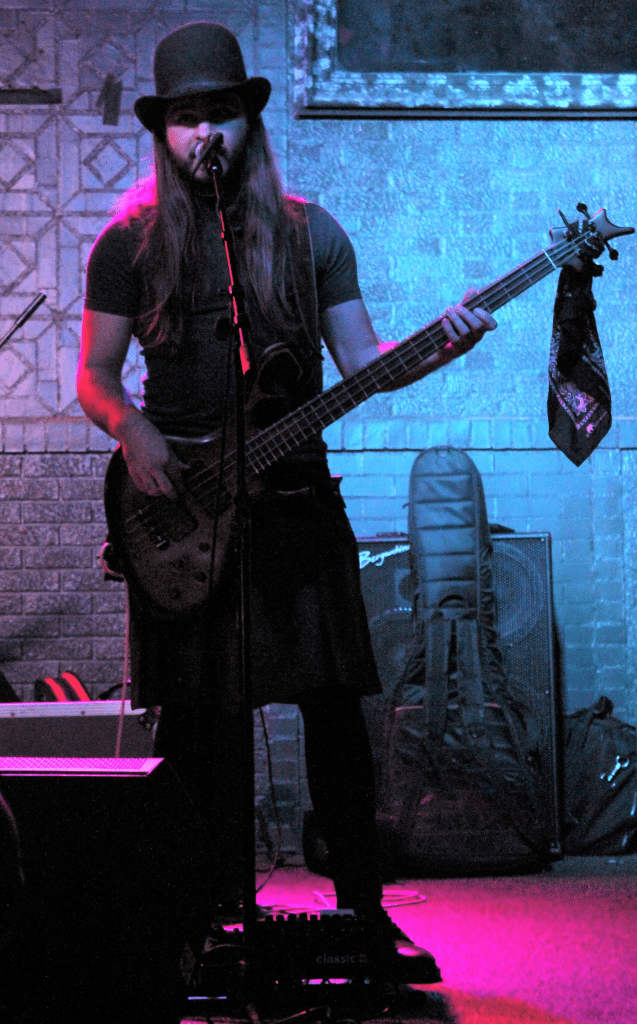
Brandon has done a few European Tours with the band Her, and Caleb Sherman from that band actually does all of our production, engineering and produces our songs. It’s been a nice little family affair.
RIPPS: I should add that Caleb is also from New York, so there’s an unruly amount of kismet in this band and it just keeps kind of showing up. You know when we were talking about doing the first batch of songs, the first record, they were like, ‘I got this guy. He’s awesome. I think you’ll really love him. The studio is dope. The vibe is amazing, and he’s from New York.’ I was like, ‘Good, no problem.’ It wasn’t even until we got to the studio and there were a bunch of HER posters hanging up, I looked around and it took me a minute, to put together that he was the guy from the band.
BISHOP: I don’t know if Brandon would do that again, but I wouldn’t put anything past him. If he can fit it into his schedule, he’ll do it. He also tours with Seven Bridges (an Eagles Tribute Band).
I met Jon through Brandon. Jon is younger than us (25), but Jon and Brandon were in a 60’s rock tribute band together. They were really good. They were fantastic, like corporate level good as teenagers. Jon was 12 years old leading the band, and he grew up with a dad who was just an encyclopedia of music knowledge. His dad plays, and Jon was drumming with multiple Motown bands, rock bands. I call Jon the ‘encyclopedia.’ He is just a 60’s and 70’s music junkie. He knows everything. I think he would probably say it’s his favorite thing in the world – 60’s rock.
RIPPS: Also, Jon was touring with his dad’s band, by the time he was 8 years old, I’m pretty sure.
BISHOP : I moved down here (Nashville) in 2010 right after high school – I was 17. I was never really good at anything as an elementary school kid. I tried to get into sports, but it wasn’t my thing. Basically, my dad was always tooling around with rock and roll music, classic rock, because in Detroit… well, it’s a rock and roll town — I think the majority of every great live album was recorded in Detroit at Cobo Hall. One day I got a guitar and just stuck with it, since I was eight years old, but I didn’t really start crafting it to the point where I was really making noise with it, until I was 12. It’s been the only thing I do every day for the last 20 years.
After moving to Nashville, Bishop got a gig touring with country artist Anthony Orio, whom he credits with helping him get his start, Todd O’Neill, winner of the 2016 ‘Nash Next’ talent competition and did a gig with Jake J and the Killjoys for a show with Bon Jovi. That same year, a chance encounter with Brian Ripps would change the direction of his career.
RIPPS: I started coming down (to Nashville) in 2016. I met Jake the first night I was in Nashville. I had a gig at Two Old Hippies, and then some buddies of mine put me up at BB King’s. They were doing what they called a ‘hootenanny.’ Everybody got up and did a couple of songs, and they had a feature artist every week. Because I was in from out of town, they said ‘we’ll put you up and you can play six songs or whatever.’
My very dear friend, Adam McDunna, who is a great songwriter, incredible singer and guitar player – he said, ‘Go over there to Big Shotz,’ and I went in and Jake was up there playing. I walked in with a guitar. I saw Jake right away because he was off his rocker killing it. I looked at him — and he looks like a young kid — but he is like this kindred spirit, because he was just killing Jimi Hendrix, and that’s how I started playing guitar.
Somebody asked for Good Times, Bad Times, the Zeppelin tune, and Jake said, ‘We all know it, but we don’t sing it,’ and I said, ‘I’ll sing it,” so Jake said, “Come here.” I went over and as he leaned away from the microphone and said, ‘Don’t just say you can do it, if you can’t do it. That shit happens all the time.’ I was like, ‘No man, I actually can.’
Jake is still exactly like this to this day. ‘You want to play one? Do you play?’ I said, ‘Yeah, I play.’ Jake was playing an American flag-painted Telecaster through a purple Marshall’s blues breaker, and he said, ‘No pedals, just volume, so if you want to clean it up, turn it down. You want to make it loud, pull it up.’ That was it.
BISHOP: I’m a sucker for the old ways of doing things.
Originally from NYC, Lead Singer Brian Ripps (35 yrs) started playing guitar at the young age of 11. Before joining King Locomotive, Brian was playing 300 shows a year at multiple weekly residencies in Manhattan opening at venues such as Gramercy Theater, Terminal 5, Irving Plaza and The Paramount for big label artists, such as REO Speedwagon, Rob Thomas, Frankie Ballard, Josh Abbott and Trace Adkins. Since 2007, Brian has released three record albums and three solo EP’s, as well.
Brian, are you still playing at any of the venues you had residency with, in New York?
RIPPS: Yes, technically, but 2020 obviously has made things particularly difficult. I was in full swing up until March 15th of last year, but once the Covid restrictions came around – New York was hit pretty hard. Most of March, April, May and parts of June, I wasn’t really doing anything. When things started to pick back up, it picked up slowly with some of the venues that I had been working with over the course of the years, but on a much smaller scale, unfortunately. I presume that once we have a little bit of this in the rear view – whenever that is – that things will start to kind of kick back into gear, but my focus, at the moment, is on Nashville and King Locomotive and this project.
How much of a focus is King Locomotive for you?
RIPPS: It’s the laser focus for the four of us. We were bizarrely, or otherwise aided somewhat, by the Covid experience, because I typically play 300 nights a year, and 90% of those are the in the New York Tri-State area, though I have been able to be in Nashville roughly once a month for the last six years almost. The idea of having a dedicated, committed project that we were going to be able to put all of our energy into, especially given Jake spends time on the road and Brandon spends time on the road – he’s actually currently in a touring tribute band and Jon is in another band that’s been touring steadily for more than 10 years — so the availability and the opportunity to make ourselves available, would have definitely been, I think, a little bit more complicated, so we’ve benefited somewhat from the situation. You have to look for those silver linings.
When did you actually form ‘King Locomotive?
BISHOP: Well, it started with us doing a gig for Brian – Brian hiring us to do a gig at an Americana fest in September of 2019. We all sat in with each other. We all enjoyed playing, and Brandon and Jon and I had always had conversations of we’ve got to start a band with that guy. That would be great, and we’re like, well, good luck, you know? We’ll never get him around, because to us he was like Paul Rodgers. We could all sing on our own, but we need that thing that we don’t have, so we did the Americana Fest gig and it went great. Then, I think that’s when the idea kind of implanted itself in our heads of how easy it was. I would say for the King Locomotive official date thing – August of 2020 really.
I’ve been playing with Brandon and Jon for almost 15 years, and that was also the big thing for us – when we play together, we know exactly how it sounds, we know exactly what we’re going to do, and Brian was the only guy that ever stepped into our circle and made it just as easy, because we’re so tight as a unit – and I hope it doesn’t sound horrible – but we get picky about who we play with. It’s the whole dynamic, you know. Brian is a brother to us. He was instantly, so it just worked out.
As to their creative process, Brian and Jacob both emphasized that the band is intensely focused on writing music that represents them as a whole, signified by a pact they made with each other from the beginning that everything would be unanimous and inclusive of all members of the band who share equal power, rather than limiting anyone to a specific role.
RIPPS: We agreed from the beginning of this band that everything had to be unanimous. It Is either everybody agrees, or we don’t do it. That Is something you would hear in documentaries about The Beatles. I always thought that was so cool, because they were much younger than us, when they started playing together. They were being saddled with really big decisions that young people aren’t always capable of making, and I think that I remember hearing Paul McCartney say that he knew it was cool, if everybody was into it. So far, we are having a really good time and I intend for it to stay that way. I have all the confidence in the world that given all of our backgrounds and runway into how we got here, that we’re all committed to keeping it this way. The really great thing to see is, … if one of your brothers says, ‘Ah, I don’t think this is the best call,’ whether you agree or not, you agree, and then you work out the whys and the when’s and everything like that. The idea is that everything is very elastic, and there is no tension because we are saying we either all can do it, all want to do it, or none of us do it and there is no going halfway. Jake says all the time, “I’d rather full-ass one thing than half ass three.”
BISHOP: I would say that pretty much lyrically, Brian is the guy, and we all said like, ‘Dude, you are the voice of the band.’ For me, I don’t even have to see a lyric, I don’t care. I trust him with my life with it. It’s one of those things that just adds something that I could never do. I write stuff, but I’d say our writing process is pretty simple. We rent a room for a couple of hours and we go in and bring our ideas, and the best idea wins that day. Then, we just expand on it. Usually, the room just tells you exactly what you’re going to write, which is the best part of it all. Then, we will have a draft down of us playing together and Brian humming. He’ll have the melody in five seconds, and a week later, he’ll send me something and the song’s fully done with his lyric. It’s great and everyone contributed.
RIPPS: I would say the great thing about this band again, and there are a lot of great things about this band — I couldn’t fucking be happier, to be honest with you — It has gone a couple of ways. In the early parts of the lockdown in March and April of last year, Jake and I were sending voice notes and little Pro Tools sessions back and forth. King Locomotive is new, but Jake, Jon and Brandon have been brothers… one unit, and I have individual relationships with everybody, but my ability to relate to the three of them as a musical mind is one of the things that drew us together, I am sure of it. Jake and I were basically doing this ping pong thing, and he was gracious enough to take one of my ideas that I’d worked on and flesh it out in Logic or Pro Tools and sent it back to me. I said, “How did you fucking do this? What else am I going to do? We should be doing more of this!” That’s how I knew that we were going to be able to go further with this.
As far as King Locomotive and writing together, one of us will have an idea – whenever Jake has a riff, or Brandon has a riff, or if Brandon and Jake got together on say something that we just completed. Jon will hum something, and l say, “Hey man, that’s pretty cool. What is that?” and I’ll just have him hum it to me again, and then we can flesh it out on that, but whatever it is, everybody contributes. Then, I can’t actually really tell you how it happens because it’s kind of insane and it tends to happen pretty quickly, but we’ll start with (in my lingo) when I write it down, the “A” part, so that’s the beginning and that’s how we get it. Once we have the “A” part that is really strong, we play that a couple times and it’s like, well, where does it go from here?
I would say one of the most important things about our band is how Jon and Brandon relate to each other, and they make decisions about the way things are going to feel. Another fly on the wall thing is like, Jake and I will be talking – ‘Heh, where do you think this should go?’ You’ll have over there Brandon and Jon saying, ‘Heh, make sure you do this.’ Then we go and we play it again and go, ‘Yeah, that’s it. That’s the right one.’
As Jake said, I’ll listen back and sort of cherry pick the things that I said off the top of my head that I found interesting and see if there is anything cohesive. Is there a message? I don’t mean message like “life lesson,” I mean, is this about something? Once you kind of find that egg, that’s how it turns into what it becomes and it makes it much easier.
I have scratch demos, voice notes of all the early stuff that we worked on, and when you go and you listen to it, you can tell when it’s almost there and I love those. The voice note recording of ‘Shakedown,’ right before it became ‘Shakedown,’ is one of the coolest things you’ll ever hear, because the ideas are all there, a lot of the lyrics are there, and you can tell that we can all tell that we were onto something, but it’s like, what is that one thing? Then, when you find it, it’s like a net you’re pulling out of the water and you’ve caught 8,000 crabs because you have the right drag. That’s our process!
If you had a fly on the wall, it would be funny for you to see, because there is a point at some time in all those sessions that we’re writing where we’re all kind of just thinking and imagining what might happen next. Somebody does it and we try it, and it either works or it doesn’t. Then we have a “B” part and usually, once you have an A and a B, the rest of it kind of falls into place, because you know what is going to work. You don’t really want to completely change the vibe, so we find that the chord structures and the energy of stuff tends to suggest, at least to me, what sort of intensity I’m going to be singing with, what type of melody is going to be drawn out of this, and what are we saying in this song.
Does King Locomotive have an album coming out soon?
BISHOP: No, not really. We’re kind of just recording things and releasing them.
RIPPS: The nice trajectory of the band, the way we have it set up now, is that there is going to be something every month through the foreseeable future. Brandon has been pretty adamant that once the first 12 songs are done, we’ll call it something and maybe get it pressed to vinyl, but that’s kind of a cross that bridge when we come to it sort of situation, because you really want to just kind of see how much traction you get with the music that you’re putting out, and people are responding very favorably. It is super flattering but also very encouraging, when you get together with your brothers to make a record or even just to write music, I think you’re putting yourself in this place. We are going to light the fuse and see kind of what explodes. When you work really tightly, especially for several hours at a time, you can kind of get into this place where either everything’s awesome, or everything’s not awesome, and that middle ground of really having people get to listen to it and express to us that they’re enjoying what we’re doing, that gives us a really clear message of stay on that track, keep doing the stuff the way that we’re doing it.
If it aint broke don’t fix it sort of thing. We don’t have to change anything right now, because we’re inspired by each other, we’re inspired by the feedback that we’re getting, and we’re inspired by the work. I think that is something so important… there’s nobody pointing a gun to our heads and saying that we have to do it. We are doing it because we enjoy it and we’re hungry for it.
RIPPS: I think that the greatest thing about a band like ours, especially in the way it came together, is that there is so much congruence to the unit. We are like a great venn diagram, so Jon has that 60’s/70’s Motown love and Jake has this incredible knowledge of blues. Brandon, while he loves that stuff and loves the blues, he also really, really loves some of the more intense metal, and he was really into pop punk and has versed himself in it.
I feel like when we play each other the ideas that we’ve come up with, there are pieces of everybody in them, and then what is going to pop most is when we all put our energy into it, so my tastes intersect perfectly with all of theirs.
I love Soundgarden, Nirvana, Steve Winwood, Stevie Wonder, Stevie Ray Vaughn, Pink Floyd, and there’s a band actually out of Nashville now, called “The Lone Bellow,” so I love this like vocal harmony rock and like country soul stuff, so we put all of that into this thing and you get, you know, driving guitar riffs with really loud fucking drums.
Your Spotify page states that you describe your music as ‘loud, aggressive, straight to the point Rock music for the new decade.’ What do you mean by that?
I think melody for me is something that has to be present, prevalent and obvious, and that’s one of the ways that it’s been so, so fun to write with this band, because there are riff rock bands everywhere, but their melodies suck, or they’re a really great vocal band, but their songs aren’t very good, so if you can do everything, if you can be everything that you are and unapologetically without having to accentuate, you can check all the boxes without having to be any one box. I think that’s one of the things that we do very well, and that’s what I think we mean when we say, ‘music for the new decade.’
Sometimes people will listen to a song and say, ‘you know, this song really reminds me of this or that,’ and I’m like, ‘Great,’ because stuff that’s great is supposed to feel familiar. It shouldn’t sound like a carbon copy, but you should feel like you’re comfortable listening to it. It’s something that you would understand and recognize, but there’s something new to it and you can’t put your finger on that, and the thing that you can’t put your finger on is what we’re doing.
BISHOP: I would say that my argument with most rock music today is that it’s trying to compete with radio pop or radio country, and it’s trying to compete and tick those boxes just to survive, and it all kind of today sounds like they thought that process out and it doesn’t sound like it’s just dudes getting together in a room and writing music and playing music together. I think that no matter what the songs come out and sound like, they sound like guys that literally get into a room for a couple hours and just play together and work out a song, because that’s what it is, and I think that’s what a lot of music in the modern era is missing is, you know – we’re in the “of the solo artist” era, and bands today are mostly run by one or two guys, and then they hire all the guns behind them. I think it’s a special thing when you have four people all contributing to the same thing.
RIPPS: …and to piggyback on that a little bit. One of the really wonderful things about the four of us versus some other bands I’ve played with and been with is, that nobody is trying to do anybody else’s job. Everybody’s position is firm, is concrete, is defined, and we all do a little bit of everything but, you know, it’s a team – a band is a ‘team.’
If you’re on a baseball team and the 3rd baseman is also trying to be the pitcher, that’s not going to work. If the short stop is just, you know, running in front of the center fielder to try and catch every fly ball, that’s not going to work either, so to have everybody in their place and a place that we enjoy being. I want to do what I’m doing. I love when Jake does what he does, and I love the way that Brandon and Jon communicate, even when we’re writing – there’s this just – you know – we say a word, but they’re backed up by just a lot of feeling and an ability to communicate that is evident in the music. Nobody is ever like, “well that’s my part.” It’s like, “no, no, no, that’s your part and I like it that it’s your part.
BISHOP: It’s just nice to have no boundaries. One of my favorite moments actually since we’ve been together is right before the Bowie’s show last month, we had a rehearsal and we took care of business, and we always try and write something – even if it’s just an idea to marinate on. Everything is about King Locomotive, the forward motion, the head of steam. We started working on something, and I think we were maybe a little bit fatigued from rehearsal and we knew the set we wanted to play and had everything kind of worked out, and we started working on something new. Brandon was the first one and he kind of looked up and said, ‘I don’t like it,’ and we were like, ‘well, what if…maybe?’ He was like, ‘no, I just think maybe let’s call it for the day,’ but he was right! He wasn’t mad, nobody was mad at each other, and it wasn’t like ‘Heh, you suck, and that’s a bad idea.’ Brandon said, ‘It doesn’t represent us as fully as I think it could, and therefore, we shouldn’t do it,’ and I dig that.
The name of the band sort of goes with your description of the kind of music you write. How did you get the name for the band?
BISHOP: Brian is the one who officially, I think, named it. Yeah, we were sitting at The Local talking, and he named it right there. We’d had a couple names go back and forth, but I could not get off the train, so to speak, of how a band it’s like a steam engine, man. It’s always about to fall apart, and it’s always like you have a caboose in the back holding everything down, you have the conductor of the band that’s being a front guy, you have me with a guy shoveling coal into the engine to keep it going, and then Brian, he named it. He really did.
RIPPS: We had a couple ideas going back and forth, and we had one or two that we really liked. If you were to go through mine and Jake’s text picture message history, it’s like this and this and this and this, and you know, we were right there with a couple of things, but he’s like, ‘but is that us? Does that describe us at all? Or does it just sound cool?’ It matters, because if it just sounds like but doesn’t mean anything…. I have a song – a solo record from a couple years ago –a song called Carry Me Home, and the second verse starts, I say, ‘head of steam, like a king locomotive,’ and I always loved that imagery and if you Google what a King Locomotive looks like, it’s pretty fucking intense, and we were sitting at The Local and Jake was like, ‘I think of us like this steam engine just fucking plowing ahead on the tracks!’ I was like, “Holy Shit, that’s it. We’re a king locomotive!’
To learn more about King Locomotive, you can keep up with them on Instagram — https://www.instagram.com/kinglocomotivemusic/, Facebook — @KINGLOCOMOTIVE and on Spotify at https://open.spotify.com/artist/1CjG4ZMJEnfpDI8LusxweN?si=yl88r-X9T7OVPW23Tnmr1w

 LOUDER THAN HELL - Nashville
Leave a comment